A proposal to end “at-will” employment prompts new city working group
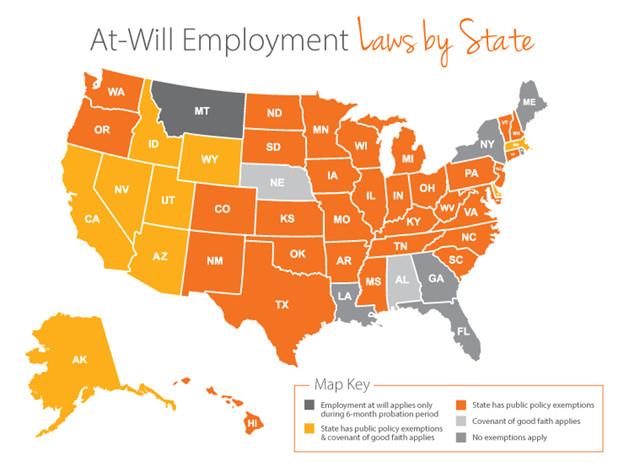
Employment at Will language and legislation originated in the 1300s throughout England in relation to farm labor and the plague limiting the number of workers available during that time period. The reduction in labor provided farmworkers the opportunity to negotiate higher wages with a threat to leave and work at another farm. Significant leverage over the employer. In 1877, Horace Gay Wood, from New York State drafted the first employment-at-will rule in the United States:
“[T]he rule is inflexible that a general or indefinite hiring is prima facie a hiring at-will and if the servant seeks to make it out a yearly hiring, the burden is upon him to establish it by proof…it is competent for either party to show what the mutual understanding of the parties was in reference to the matter; but unless there understanding was mutual that the service was extend for a certain fixed definite period, it is an indefinite hiring and is determinable at the will of either party.” (Understanding Employment Law, 2nd Edition)
Since 1877, there have been many court cases, laws and regulations that currently establish the employment-at-will doctrine we are familiar with today. At-will employment is the baseline legal rule in all states except Montana, which passed the Wrongful Discharge from Employment act in 1987. “Under this statute, after an employee has passed a probationary period, the employer cannot fire the employee absent “good cause,” which the statute defines as “reasonable job-related grounds for dismissal based on a failure to satisfactorily perform job duties, disruption of the employer’s operation, or other legitimate business reason.”” (Understanding Employment Law, 2nd Edition) What does this all mean for our organizations? Employment-as-will is still the governing legislation throughout the country. The employer can fire an employee and the employee can quit. Laws like Title VII of the Civil Rights Act of 1964 have redefined how employers can fire employees. We cannot fire an employee based on protected classes, example race, religion, age, disability, etc.
There are three major common-law exceptions to the employment at will doctrine. These exceptions are based on a state’s case law. The exceptions, described in the following slides, are:
- Public policy.
- Implied contract.
- Covenant of good faith and fair dealing.
Public Policy
This is the most widely accepted exception (42 states).
Under the public-policy exception, an employee is wrongfully discharged when the termination is against an explicit, well-established public policy of the state.
The majority view among states is that public policy may be found in a state constitution, a statute or an administrative rule, but some states have either restricted the doctrine or expanded it beyond this boundary.
Implied contract
The second major exception to the employment at will doctrine occurs when an implied contract is formed between an employer and employee, even though no express, written instrument regarding the employment relationship exists.
Although employment is typically not governed by a contract, an employer may make oral or written representations to employees regarding job security or procedures that will be followed when adverse employment actions are taken. If so, these representations may create a contract for employment. This exception is recognized in 36 of the 50 states.
Covenant of good faith and fair dealing
The exception for a covenant of good faith and fair dealing represents the most significant departure from the traditional employment at will doctrine.
Rather than narrowly prohibiting terminations based on public policy or an implied contract, this exception—at its broadest—reads a covenant of good faith and fair dealing into every employment relationship.
Additional Exceptions to Employment-at-Will:
- Union Contract Clauses
- Employment Contracts for Set Lengths (I receive 1-year contracts at Elmira College)
- Executive Contracts
- Professional and Collegiate Coaching Contracts
Where to Include Employment-at-Will Language:
- Job Offer Letters
- NYS Wage Theft Notification (Modify an Offer Letter to Include all Required Information)
- Employee Handbook (Include on Signoff Page and it is not a contract)
- Employee Policies (Include on Signoff Page)
- Other Training (I include this on other policy signoffs as well)
- Performance Improvement Plan
- Last Chance Agreement
Draft At-Will Language:
“Your employment with [employer name] is at will. This means your employment is for an indefinite period of time and it is subject to termination by you or [employer name], with or without cause, with or without notice, and at any time. Nothing in this policy or any other policy of [employer name] shall be interpreted to be in conflict with or to eliminate or modify in any way, the at will employment status of [employer name] employees.
The at will employment status of an employee of [employer name] may be modified only in a written employment agreement with that employee which is signed by the President, or the Chairman of the Board of Directors, of [employer name].
By your signature below, you acknowledge your understanding that your employment with [employer name] is at will, and that nothing in this handbook is intended to constitute a contract of employment, express or implied.” (SHRM)
Employment at will is a legal doctrine which states that an employment relationship may be terminated by the employer or employee at any time and for any or no reason as long as no laws are violated. Some form of employment at will is recognized in all states except Montana and can be nullified by an express or implied employment contract.
Other Thoughts and Considerations of At-Will Disclaimers:
- Prominence of Language: “must not be buried in the fine print, should be placed at the front of the manual and ideal should be set off by font, color, or border…sign an acknowledgement form stating at-will language.” (Understanding Employment Law, 2nd Edition)
- Specific Language: Employment is at will, clear and understandable by the “average” worker
- The Handbook or Offer Letter is not a contract
- The employer reserves the right to modify at any time with no notice, terms of the handbook or policy and/or the employment relationship
Include a section for the employee signature, printing the employee name and date. I recommend a witness signature as well. Remember to review federal, state and local laws prior to adding, modifying or updating any employment-at-will policies, offer letter or other language. State and locals can and do have different requirements.
As laws and regulations have evolved over the decade’s employment-at-will is not as clear cut as it once was. The employment-at-will language needs to be understandable to all employees in the organization. Train managers and supervisors on what employment-at-will means and exceptions to these rules. Seek guidance before adding or updating any employment-at-will handbook, offer letter, policy or training language. If you change handbook language, communicate these updates to the workforce. This is not legal advice.
New York City Proposal
If passed, the legislation could transform the balance of power between bosses and their employees. Employees’ jobs would be legally protected unless their boss could demonstrate misconduct, unsatisfactory performance or a genuine economic need to eliminate their position. Workers who believe they are terminated without just cause would be able to bring legal claims before city enforcers, arbitrators or state court judges.
The bill also would restrict companies’ use of technology to surveil and assess workers’ performance and would permit the city comptroller to bring cases on behalf of fired employees, even if those workers had signed forced arbitration clauses giving up their rights to sue.
(Bloomberg Government, subscription only)
Fast-Food Workers
The fast-food industry in New York City already has a just-cause requirement for terminations. An ordinance signed into law in 2021 requires that an employer seeking to fire a fast-food worker must do so for just cause, following progressive discipline. The law prohibits significantly cutting employees’ hours. When just-cause dismissal is required, the termination must be for a reason as defined by a statute or collective bargaining agreement. Employee discharges based on a bona fide economic reason must be done in reverse order of seniority so that employees with the greatest seniority are retained the longest and reinstated or have their hours restored first.
At-Will Employment
In the United States, the doctrine of at-will employment refers to an employment relationship between an employer and an employee, under which either party can terminate the relationship without notice, at any time and for any reason not prohibited by law. The at-will doctrine is the presumed relationship between employers and employees except when a formal contract or agreement exists.
Montana is the only state that requires a just cause for termination. However, during a 12-month probationary period, Montana employers can fire workers without just cause. (SHRM)
What is Employment At-Will?
Employment at will is the principle that an employer can terminate employment for any reason, provided that is not illegal. All states have some form of employment at will although mostly with some restrictions—notably Montana, in line with European nations, only allows this during an initial 6-month probation period.
Which states are not at-will employment states?
All states have some form of employment at-will although mostly with some restrictions—notably Montana, in line with European nations, only allows this during an initial 6-month probationary period.
What are the Advantages of Employment At-Will?
In theory, at-will employment offers freedom and flexibility to both employers and employees. It gives employers the financial security to reduce labor costs fast. It also means that employees can choose to leave a job they dislike without having to work any notice period. However, critics claim that at-will employment leads to job insecurity, disadvantaging workers.
Can Terminated At-Will Employees Collect Unemployment?
State law determines who is eligible for unemployment benefits, how much each individual will receive and for how long they will receive it. And, every case is unique. However, many states often allow at-will employees who have been terminated through no fault of their own to qualify for unemployment benefits. Employers who do terminate at-will employees should keep in mind that unemployment claims could trigger an increase in unemployment insurance taxes.
Exemptions to Employment at Will
- Public Policy Exemption
The majority of states apply some form of public policy exemption, preventing the termination of an employment relationship if this would violate public policy. This means that an employee can’t be fired for refusing to do something that would go against state law, for reporting a violation of the law or when an employee has acted in the greater good of the public, like performing jury duty.
- Covenant of Good Faith
Many states also maintain a further exception: requiring employers act in good faith. For instance, the termination of an employee’s employment relationship immediately before they were due to receive a large commission could be interpreted as being in bad faith. Similarly, an employer cannot give false reasons for an employee’s termination.
This covenant could also be violated in a case where an employee was terminated after a long time where they had been given positive performance reviews and led to believe that their job was secure—in order to prove that the termination had not be conducted in bad faith, employer’s might be expected to show “just cause”.
- Implied Contract Exemption
A further common exemption is for cases when a contract, employee handbook or other employer behavior implies that an employee will only be terminated for “just cause”—even when employees have signed contracts stating that their employment is at-will. Formal collective bargaining agreements are generally negotiated with high-level employees.
Additional Statutory Exceptions
While the exemptions listed above apply only in certain states, there are other circumstances in which employment at will doesn’t apply:
- Public Sector Employees
Typically, public-sector employees are not subject to at-will employment.
- Unionized Jobs
When employment contracts are the subject of union bargaining, a common demand is that employees can only be terminated for “just cause”.
- Contract Workers
If employees have a contract that lists a specific start and end date, there will likely be stipulations on the exact circumstances in which the contract can be terminated.
- Discrimination
Civil rights legislation protects employees from termination in the case of discrimination on the basis of race, gender, religion, national origin, sex, genetic information or age.
- Protected Employment
Employment cannot be terminated when an employee is on job protected leave, such as that under the Family and Medical Leave Act legislation.
- Whistleblowing
State and federal laws protect whistleblowers against retaliation. (Paycor)
| State | Public Policy Exemption | Covenant of Good Faith | Implied Contract Exception |
| Alabama | No | Yes | Yes |
| Alaska | Yes | Yes | Yes |
| Arizona | Yes | Yes | Yes |
| Arkansas | Yes | Yes | Yes |
| California | Yes | Yes | Yes |
| Colorado | Yes | Yes | Yes |
| Connecticut | Yes | Yes | Yes |
| Delaware | Yes | Yes | No |
| Florida | No | No | No |
| Georgia | No | No | No |
| Hawaii | Yes | Yes | Yes |
| Idaho | Yes | Yes | Yes |
| Illinois | Yes | Yes | Yes |
| Indiana | Yes | Yes | No |
| Iowa | Yes | Yes | Yes |
| Kansas | Yes | Yes | Yes |
| Kentucky | Yes | Yes | Yes |
| Louisiana | No | No | No |
| Maine | No | No | Yes |
| Maryland | Yes | Yes | Yes |
| Massachusetts | Yes | Yes | No |
| Michigan | Yes | Yes | Yes |
| Minnesota | Yes | Yes | Yes |
| Mississippi | Yes | Yes | Yes |
| Missouri | Yes | Yes | No |
| Montana* | Yes | Yes | No |
| Nebraska | No | Yes | Yes |
| Nevada | Yes | Yes | Yes |
| New Hampshire | Yes | Yes | Yes |
| New Jersey | Yes | Yes | Yes |
| New Mexico | Yes | Yes | Yes |
| New York | No | No | Yes |
| North Carolina | Yes | Yes | No |
| North Dakota | Yes | Yes | Yes |
| Ohio | Yes | Yes | Yes |
| Oklahoma | Yes | Yes | Yes |
| Oregon | Yes | Yes | Yes |
| Pennsylvania | Yes | Yes | No |
| Rhode Island | No | No | No |
| South Carolina | Yes | Yes | Yes |
| South Dakota | Yes | Yes | Yes |
| Tennessee | Yes | Yes | Yes |
| Texas | Yes | Yes | No |
| Utah | Yes | Yes | Yes |
| Vermont | Yes | Yes | Yes |
| Virginia | Yes | Yes | No |
| Washington | Yes | Yes | Yes |
| West Virginia | Yes | Yes | Yes |
| Wisconsin | Yes | Yes | Yes |
| Wyoming | Yes | Yes | Yes |
* Employment at will only applies during 12-month probation period.
 Talentscape, LLC